
Event Schedule – Day 2
SATURDAY, SEPTEMBER 13, 2025
AFTEROON SESSION
All times are CDT (UTC −05:00)
2:00 – 2:10 pm CDT
ADVAITA VEDANTA (Non-dualism)

Introduction to topic by Emcee Swami Sarvapriyananda
2:10 – 2:25 pm CDT
Stotra Path (Nirvana Shatakam)
निर्वाणषट्कम् [Nirvāṇaṣaṭkam]
ॐ मनोबुद्ध्यहङ्कारचित्तानि नाहं न च श्रोत्रजिह्वे न च घ्राणनेत्रे ।
न च व्योम भूमिर्न तेजो न वायुश्चिदानन्दरूपः शिवोऽहं शिवोऽहम् ॥१॥
ōṁ manōbuddhyahaṅkāracittāni nāhaṃ na ca śrōtrajihvē na ca ghrāṇanētrē ।
na ca vyōma bhūmirna tējō na vāyuścidānandarūpaḥ śivō’haṃ śivō’ham ॥1॥
न च प्राणसंज्ञो न वै पञ्चवायुर्न वा सप्तधातुर्न वा पञ्चकोशाः ।
न वाक्पा णिपादं न चोपस्थपायूचिदानन्दरूपः शिवोऽहं शिवोऽहम् ॥२॥
na ca prāṇasañjñō na vai pañcavāyurna vā saptadhāturna vā pañcakōśāḥ ।
na vākpāṇipādaṃ na cōpasthapāyūcidānandarūpaḥ śivō’haṃ śivō’ham ॥2॥
न मे द्वेषरागौ न मे लोभमोहौ मदो नैव मे नैव मात्सर्यभावः ।
न धर्मो न चार्थो न कामो न मोक्षश्चिदानन्दरूपः शिवोऽहं शिवोऽहम् ॥३॥
na mē dvēṣarāgau na mē lōbhamōhau madō naiva mē naiva mātsaryabhāvaḥ ।
na dharmō na cārthō na kāmō na mōkṣaścidānandarūpaḥ śivō’haṃ śivō’ham ॥3॥
न पुण्यं न पापं न सौख्यं न दुःखं न मन्त्रो न तीर्थं न वेदा न यज्ञाः ।
अहं भोजनं नैव भोज्यं न भोक्ता चिदानन्दरूपः शिवोऽहं शिवोऽहम् ॥४॥
na puṇyaṃ na pāpaṃ na saukhyaṃ na duḥkhaṃ na mantrō na tīrthaṃ na vēdā na yajñāḥ ।
ahaṃ bhōjanaṃ naiva bhōjyaṃ na bhōktā cidānandarūpaḥ śivō’haṃ śivō’ham ॥4॥
न मृत्यु र्न शङ्का न मे जातिभेदः पिता नैव मे नैव माता न जन्म ।
न बन्धुर्न मित्रं गुरुर्नैव शिष्यश्चिदानन्दरूपः शिवोऽहं शिवोऽहम् ॥५॥
na mr̥tyurna śaṅkā na mē jātibhēdaḥ pitā naiva mē naiva mātā na janma ।
na bandhurna mitraṃ gururnaiva śiṣyaścidānandarūpaḥ śivō’haṃ śivō’ham ॥5॥
अहं निर्विकल्पो निराकाररूपो विभूत्वा च्च सर्वत्र सर्वेन्द्रि याणाम् ।
न चासङ्गतं नैव मुक्तिर्न मेयश्चिदानन्दरूपः शिवोऽहं शिवोऽहम् ॥६॥
ahaṃ nirvikalpō nirākārarūpō vibhūtvācca sarvatra sarvēndriyāṇām ।
na cāsaṅgataṃ naiva muktirna mēyaścidānandarūpaḥ śivō’haṃ śivō’ham ॥6॥
ॐ स॒ह ना॑ववतु । स॒ह नौ॑ भुनक्तु । स॒ह वी॒र्यं॑ करवावहै ।
ते॒जस्वि॒ ना॒व॑धीतमस्तु मा वि॑द्विषावहै ᳚॥
ॐ शान्तिः॒ शान्तिः॒ शान्तिः॑ ॥
ōṃ sa̱ha nā̍vavatu । sa̱ha nau̍ bhunaktu । sa̱ha vī̱rya̍ṃ karavāvahai ।
tē̱ja̱svi nā̱va̍dhītamastu mā vi̍dviṣāvahai̎ ॥
ōṃ śānti̱ḥ śānti̱ḥ śānti̍ḥ ॥

Swami Ishatmananda
2:25 – 2:50 pm CDT
Advaita Vedanta Pre-Shankaracharya
Talk by Swami Tattwamayananda
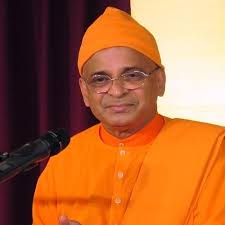
Swami Tattwamayananda
2:50 – 3:15 pm CDT
Advaita Vedanta during Shankaracharya
Brief Ouline
Based on the teachings of his teachers and three canons of Sanatana Dharma- the Upanishads, the Bhagavad Gita, and the Brahma Sutras, Adi Shankaracharya gave us a path to discover the ultimate Truth beyond the surface differentiation and find the unity of all existence. This illusion of multiplicity caused by Maya can be transcended through proper understanding, removing all doubts by contemplation and merging in the ultimate reality, Brahman, and freedom is attained.
Topic Summary
Adi Shankaracharya, in a short lifespan of 32 years, left an indelible mark on the intellectual and spiritual sphere of the world through his philosophy of Advaita Vedanta. Born in 788 CE, Shankara’s teachings continue to influence all serious seekers of truth. Drawing from the wisdom of the Upanishads, the nondual approach, Advaita, affirms that there is only one ultimate reality, Brahman, and that all differentiations, including those between the self (Atman) and the universe, are illusory. Shankara uses robust logic to guide us towards the realization of that the Ātman, that is, the individual self, and Paramatman, the Supreme Self, are not really different. Not different also are Nirguna and Saguna Brahman. These appear different because of Maya, and the path to freedom is through self-knowledge by removing ignorance.
Sri Shankaracharya inherited the most notable work Mandukya Karika, a foundational work on Advaita philosophy from his teacher’s teacher, Gaudapada. He writes that he received Advaita knowledge from the teachers that preceded him. We don’t find any other work of such teachers present during his lifetime. His guru Sri Govinda Bhagavad-Pada, however, inspired him to spread non-dualism. We don’t find any of his works either. So, it can be safely said that Sri Shankaracharya single handedly established the Advaita philosophy through his non-dual commentaries of 10 or 11 Upanishads, Brahma Sutras, Bhagavad-Gita, some prakarana granthas, and many hymns. The prakarana granthas (explanatory helping books) such as Vivekachudamani, Upadesha-Sahasri, Atma-Bodha, Aparokshanubhuti, Vakya Vritti, Prshnottara Ratnamalika, Prabodhasudhakara, Tattva bodha, Dasha-Shloki, Shata-Shloki, are attributed to him.
Four principal disciples of Adi Shankaracharya, acharyas Padmapad, Hastamalaka, Trotaka, Sureshwara, and ten monastic orders established by him nourished non-dualism and disseminated it further.
Advaita or “non-duality” or “not two” contrasts with dualistic experiences and philosophies, which view the universe as consisting of more than one fundamental, opposing realities—such as God, individual self and the world, or soul and body. According to Shankara, such distinctions are not real. The ultimate reality, Brahman, is the only true existence, and everything else, including the universe and individual selves, is a projection of singular reality.
We mistakenly perceive the world as consisting of multiple distinct objects and beings. This perception arises from ignorance (Avidya or Maya), because of which we cannot experience the oneness of all entities. The goal of Advaita is to overcome this ignorance through knowledge (Jnana), leading to a direct realization that Atman is identical with Brahman, the supreme reality. Brahman can be presented in two distinct forms: Nirguna Brahman and Saguna Brahman. These are different ways of experiencing and understanding the ultimate reality, but they are not contradictory. Rather, they reflect two levels of truth.
According to Shankaracharya, Nirguna Brahman refers to the highest, unmanifested form of Brahman—pure consciousness without attributes. This is the ultimate reality, beyond human comprehension, where there is no differentiation, no limitation due to attributes, hence no multiplicity. Nirguna Brahman is beyond the reach of sensory perception, intellect, and language. It is ineffable and formless, existing beyond time, space, and causality.
The reality of Nirguna Brahman is the only truth that exists, and everything else we perceive is due to covering and projecting power of Maya. This ultimate reality can be realized through proper hearing and understanding, self-enquiry and profound meditation. A sincere seeker can realize this ultimate, formless truth by negating multiplicity and transcending the material world and the ego (the false sense of individuality) through right knowledge.
Saguna Brahman refers to the concept of Brahman with attributes. This form is the manifest, visible, and personal aspect of the ultimate reality, which can be experienced through worship, devotion, and the cultivation of divine qualities such as kindness, truthfulness and selfless service. For many people, the perception of God as Saguna Brahman in the form of deities like Vishnu, Shiva, or Devi is an accessible means of experiencing divinity in everyday life.
Shankaracharya does not see Saguna Brahman as a contradiction to Nirguna Brahman. Instead, he argues that Saguna Brahman is an intermediary form, a way for human beings to relate to the unmanifest reality. While the ultimate truth remains Nirguna Brahman, the manifestation of that reality in a personal form is a legitimate way for the devotee to approach divinity. However, from the perspective of Advaita Vedanta, this is still a relative truth, which will eventually give way to the realization of the non-dual Brahman when the seeker attains spiritual maturity.
Maya or Ignorance: According to Shankara, the world that we perceive through our senses is not the ultimate reality; rather, it is an appearance (or “Maya”) superimposed on the unchanging, eternal Brahman. Just as a dream appears real while one is dreaming but vanishes when one wakes up, the world of multiplicity is an illusion that disappears when one awakens to the truth of non-duality. Maya is the force that causes us to perceive duality, the separation between the self and the universe, between God and the world. It creates the illusion of individual identities, objects, and events, all of which are ultimately transient and unreal. Shankara compares this illusion to the illusion of a snake on a rope. When one sees a rope in the dark, one mistakes it for a real snake, but when the light shines on the rope, one realizes that it was never a snake. Through the process of hearing and understanding, self-enquiry, and deep meditation, a seeker can gradually dispel the ignorance caused by Maya and come to see all multiplicity as it truly is—a manifestation of Brahman. This process of awakening is the key to liberation (Moksha).
The Path, Knowledge and Self-Realization: The central path to liberation in Advaita Vedanta is Jnana Yoga, or the path of self-enquiry. Unlike other spiritual practices that may emphasize rituals or devotion, Shankara emphasized the power of knowledge in realizing the non-dual nature of reality. The essential practice of Advaita Vedanta is self-inquiry: the questioning of the nature of the self, “Who am I?”
According to Shankara, this self-inquiry leads to the understanding that the individual self (Atman) is not separate from Brahman. Atman is Brahman. This realization, which transcends all intellectual understanding, is a direct experience of unity with the divine. Shankara’s teachings suggest that by stripping away all false identities—such as those based on the body, mind, and ego—one can reach the ultimate truth that the self is pure consciousness, identical with the all-pervading Brahman.
The realization of the self as Brahman leads to liberation (Moksha), which is freedom from the cycle of birth and rebirth (Samsara). This liberation is not just an intellectual understanding but an experiential transformation. Once the veil of Maya is removed, the seeker experiences the unity of all existence and is freed from the attachments, desires, and ignorance that bind the soul to the cycle of suffering.
Adi Shankaracharya invites us to look beyond the surface distinctions of the world and see the unity of all existence. Through the realization of the oneness of Atman and Brahman, we can transcend the illusion of Maya and attain liberation from the cycle of birth and death.
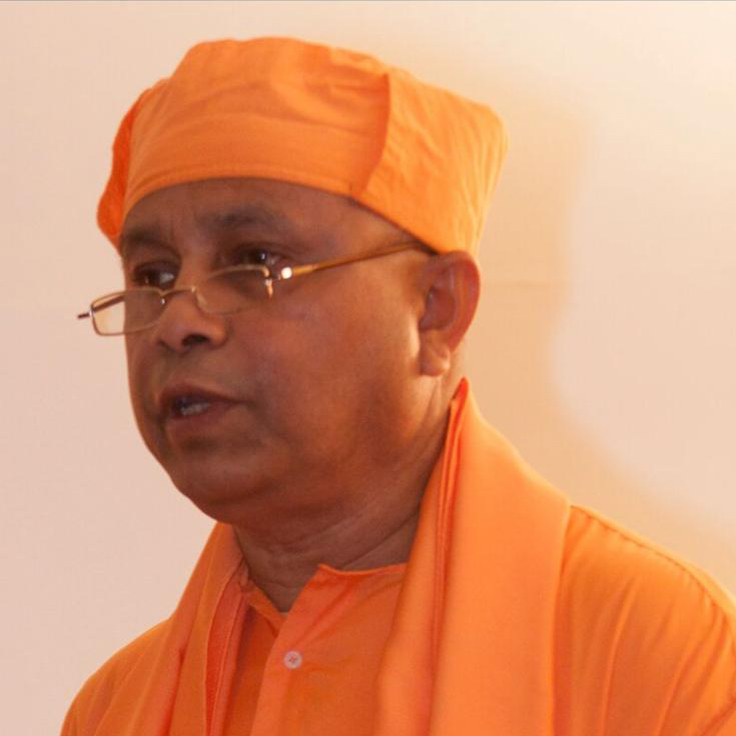
Swami Chandrashekharananda
3:15 – 3:40 pm CDT
Advaita Vedanta Post-Shankaracharya
Topic Summary
Shankaracharya in his teachings emphasized 3 issues:
- Non-Duality of Brahman or Brahman is only reality.
- Maya: The unreality of the world experienced physically also whatever is perceived by the mind.
- Oneness of the individual consciousness with Brahman.
For continued propagation of his teachings, he wrote interpretation of the Upanishads, the Bhagavad Gita etc. He also set up four monasteries in four corners of India. They were headed by his learned monastic disciples. The tradition of succession is continuing. He also reformed Hinduism and its practices. He left a number of manuals for experiential proof of his teachings.
Three intellectual schools were developed based on his teachings known as Bhamati, Vivarana and Vartika. In fact, the importance was shifted from experience to argumentation. From an experiential point of view not much is known in the field of Advaita Vedanta until the advent of Sri Ramakrishna and Swami Vivekananda. Probably the teachers of Advaita Vedanta did not come into prominence due to the popularity of different cults until the advent of Sri Ramakrishna and his disciple Swami Vivekananda.
At present due to the advancement of science and technology Advaita thoughts are getting renewed interest.
Swami Vivekananda said: “I make bold to say that the only religion which agrees with, and goes a little further than modern researchers, both on physical and moral lines, is Advaita, and that is why it appeals to modern scientists so much. They find that the old dualistic theories are not enough for them, do not satisfy their necessities”
Swami Prapannananda
03:40 – 4:05 pm CDT
Advaita Vedanta Propagated by Women Sages
SUMMARY of Presentation on “Advaita Vedānta Propagated by Women Sages”
Vedas, the primary Pramāṇa for the Āstika Darśanas amongst our nine Bhāratia Schools of Philosophy, is designated as “Śruti Mātā”, The Scripture as Mother. It is thus most fitting that Her paramount teachings be propagated through the medium of our female Sages of Bhārata Varṣa, the mother figures within spirituality. Amongst these six Āstika Darśanas, the Advaita Vedānta principles of the Uttarmīmāmsakas shall be explored through the female persona of Gārgī Vācaknavī, our Yajurveda Brahmavādinī, belonging to the lineage of the legendary Bharadvāja Ŗiṣi. Through the examples of her magnanimous presence amongst even fellow male scholars of the time, along with the teachings of Sage Vāk Devī uncovered in the Upaniṣads of the Rigveda, the presence and potency of our women saints of Bhārata shall be traversed and unveiled.
Brahmacharini Jyoti Chaitanya
4:05 – 4:30 pm CDT
Question and Answer
All Swamijis and Matajis on stage
